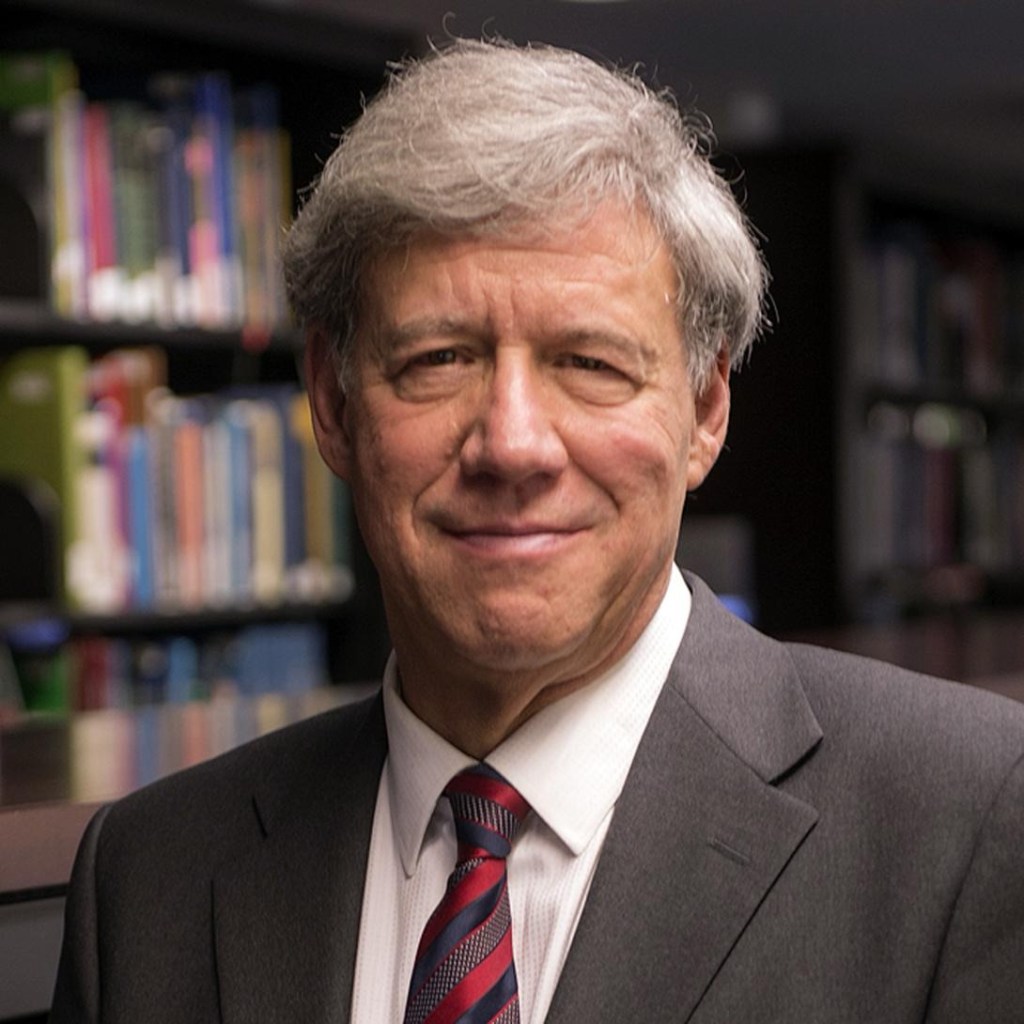
“People have to recognize the stakes. They are very, very high, and they’ve never been this high in my lifetime, ever. Not even close in terms of the potential future for this world, this society and this democracy.” This is how Professor Geoffrey Stone described the 2024 Presidential election when I sat down with him 18 days from election day.
Geoffrey R. Stone currently serves as the Edward H. Levi Distinguished Service Professor at the University of Chicago Law School, where he served as the Dean of the Law School from 1987 to 1994. He then occupied the position of Provost of the University from 1994 to 2002. In 2013, President Obama appointed Professor Stone to serve on the President’s Review Group on Intelligence and Communications Technologies. Professor Stone has written amicus briefs for constitutional scholars in multiple Supreme Court cases including Obergefell v. Hodges (2015).
Professor Stone’s expertise lies in constitutional law and individual rights. His latest work is Roe v. Dobbs: The Past, Present, and Future of a Constitutional Right to Abortion written in collaboration with Lee C. Bollinger (Stone & Bollinger, 2023).
I want to start with a broad question. How do you assess the current political climate in relation to civil liberties in the US?
I think the current political climate is very troubling, not only because I think that Donald Trump is quite dangerous and irresponsible, reckless and threatening to democracy, but [because] I think that the practical reality at the moment is that there are real dangers toward democracy that come in part from his misleading [of the] American people about a broad range of issues and the changes in the nature of the media have had a dramatic impact.
It used to be the case, if you go back to when I was your age, in which basically everybody got their news from ABC, NBC, CBS, New York Times, Washington Post, Wall Street Journal and it was all pretty responsible and balanced. The law under the Fairness Doctrine required that radio and TV stations be fair and balanced in their presentation of news. That ended with the Reagan administration, which eliminated the Fairness Doctrine, and then with the advent of first cable and then social media the reality is that most Americans today get their news and information from not at all neutral, fair or balanced sources. I think that has led to a real challenge to the effectiveness of democracy, because we have people who now hold beliefs about the world that are not, in fact, necessarily, well grounded in reality. That’s not the ideal of how a democracy should function.
You discuss this in your recent work Social Media, Freedom of Speech, and the Future of our Democracy with Lee Bollinger. Could you expand on the work, do you believe there is a solution to the issue you raise?
I think there are potential solutions. One thing, I’m not sure I want to encourage this, but one thing that would be possible, for example, would be to have a law similar to the Fairness Doctrine that would require internet sites to provide viewers with both perspectives when they like something. For example, if you go to a site on Facebook and it takes a radically left wing or right wing position and you like it, instead of giving you more and more things along the same perspective, which is what it currently does, A law that would say, “no, you have to give people both sides.” That’s kind of what the Fairness Doctrine used to be like. I think if that were held to be constitutional and it were enacted, it would be a positive thing in terms of reducing some degree of radicalization.
Do you believe that this is primarily a social issue or a legal issue?
I think it’s both. I think people need to be educated about the risks of allowing themselves to be manipulated in a way that’s now much more possible than used to be the case. They should be aware of the fact that, both with respect to social media and also with respect to even TV stations which are no longer balanced, particularly on cable and so on, that they run the risk of seeing only a very distorted view of the world. Therefore, I think part of it is educating people that this is not good for them as individuals, nor is it good for a democracy. Sort of what the Uuniversity of Chicago’s core values are as an institution is something that the nation should be following, but the problem is that’s not the culture today and I think people don’t have a strong sense that that’s what they should be doing.
I think educating people, including current students, about the importance of being open to and accessing different perspectives, thinking about them and not allowing oneself to be brought into a box in which they only hear one side of things is important for them to recognize for their own sake.
You mention education on both the individual and institutional levels, and so I wanted a bit of clarification. Do you believe there is something we can do within our educational systems to teach these values at the beginning stages of development whether it is at the elementary or middle school level?
I think it is very important, given the realities of our current technology and society, that people be educated from the time they’re kids to the time they’re my age. They are subject to dangers in the sense that they can be easily manipulated by being exposed over and over again to particular points of view without even realizing that’s what’s happening and that it is distorting their own thinking. I think that therefore, educating young people is critical, but I think it’s also important for people in general throughout society to be informed about those dangers and to be encouraged to seek alternative perspectives.
Do you see a real possibility where these reforms push through the House and Senate to become real policies and become enacted?
Good question. It’s possible that that would happen. There’s also the question of whether it would be constitutional, which is another issue. I would like to imagine a world in which Congress could take a deep breath and step back and say there are dangers and threats to the effectiveness of our democracy right now and in order for democracy to function well, people need to be exposed to different perspectives. That’s sort of built into the norms of a democracy.
Ideally, you hear both sides and you make your own judgments. It was never perfect, obviously, but I think that we were much better at that in the past than we are today. So, I do think that both educating people about that and about the importance of it for themselves as individuals, is critical. I also think that it’s important for the government to think about ways in which they can effectively implement that.
I know you’ve done standing work in other branches of the government, specifically with the religious affiliations of the Supreme Court justices. You recently published a work titled Roe v. Dobbs which examined the history of abortion restrictions and legalization within the U.S. Given the current makeup of the Supreme Court, what role will the judicial branch have in shaping key policies going forward post-election?
I think the current Supreme Court is pretty reckless and politically ideological in a way that the court has never been in over a century. It used to be the case that Republican appointed justices were thought of as quite conservative, but compared to the current justices, they were relatively moderate, so people like Warren Berger and Lewis Powell, John Paul Stevens and Sandra Day O’Connor were thought of as conservative but they were nothing at all like the current justices.
I think that poses another danger toward democracy right now because they are so politically ideological in their decision making process. It is dangerous because there is no civil solution to it because you can’t get rid of them in any obvious way and adding new justices, which some people suggest, would be highly problematic. If the Democrats added more justices then when the Republicans are in control, they’ll add more justices.
It would be good if the justices would learn to be more responsible. But I don’t know whether that’s realistic. I think the current Supreme Court is supposed to be in its ideal form, as illustrated by, say, the Warren Court, a protector of democracy and a protector of those who are vulnerable in our society to majoritarian abuse or indifference. They’re also supposed to be fundamentally concerned about protecting democracy and making sure it works effectively. If you look at decisions of the Warren Court, that’s exactly what they did. Things like one person, one vote and protecting freedom of speech.
A lot of what you have been discussing from the previous question and even going back earlier to our discussion of the media comes down to the conclusion that part of our politics has become quite dirty. How do we remove the bad politics out of it, out of our good policy?
I think politics has become dirty in part because of the influence of money, which has had a significant distorting effect. Corporations and the billionaires are not supposed to have the kind of influence that they currently have both on the electoral process and on the behavior of elected officials who want their support.
One example of this is several years ago. I’ve testified before various congressional committees, and several years ago I was testifying before a congressional committee, and normally what would happen is that all the members of the committee would be there during the entire hearing. I noticed that during this particular proceeding, which was about national security, that only a few members of the committee would be there at any given moment. When it was their turn to ask questions, they would come in and ask their questions and then they would leave. They weren’t there for most of the hearings. Afterwards, I asked Amy Klobuchar, who was one of the members of the committee and a former student of mine here at the law school, what’s going on? Why are they not here? And she said, Oh, they’re back there talking to donors. That was very revealing in terms of how that distorts their responsibilities. [Members of the committee] are supposed to be in these hearings and engaging and listening and asking questions and trying to understand, in this context, it was very important national security issues. But instead, as Amy said, they were back there talking to donors about other issues, just trying to raise money.
So going forward into the next presidency, what is the thing you hope to see done differently?
I have very few hopes for Donald Trump as president. I don’t think he was a good president last time, and I think he’s become far more crazy and radical in the time since then, and I worry deeply about what will happen to this nation if Donald Trump is elected. Now, maybe that’s exaggerated. It’s at least possible that it’s exaggerated, but nothing that he has said or done in his behavior gives me any reason to hope that he will be a thoughtful and responsible president, as people like George Bush or even Ronald Reagan were, even though I disagreed with them as a liberal. They [Bush and Reagan] were thoughtful and they were responsible, and they tried to figure out with a fair mind what was in the best interest of the country. I don’t think Donald Trump is capable of that anymore and I think the Republican Party has gone completely off the deep end.
You think about people like John McCain, they are Republicans, but they are much more normalized Republicans. I didn’t agree with many of the things they believed in. Liz Cheney, who is a former student of mine, has been terrific, at least, in recognizing the dangers that Donald Trump poses to the country. It’s amazing to me that so few Republicans are really willing to follow her lead. That they just are so afraid of him that they’re unwilling to, because they know better. I mean, I do believe that they know better. I do believe that, like Liz, they understand the actual dangers that Trump poses to this country, but they’re just not willing to take it on because they’re afraid it will: a. cost them their jobs and b. it will only radicalize things worse if they’re not in their offices. The practical reality is the Republican Party has simply stopped being responsible, and that’s just terrifying. There’s never been anyone like Donald Trump in American national politics in our history in terms of his craziness and irresponsibility and it’s scary. That’s not what it’s supposed to be like.
How do you view the future of the nation?
I mean, I really worry when I think about my kids and my grandkids. I tell my students that you should be really concerned and actively concerned about the future of this country for you, your kids and your grandkids, because you want them to live in a society that is fair, decent, respectful, open-minded but we now are at a point where those values may well be tossed under the rug.
Do you really want your kids and your grandkids growing up in that kind of society, which is not the one that you imagined yourself being living in? I think that’s a danger now in a way that it hasn’t been before. We’ve had moments in our history when there have been specific issues like that during the Communist era, for example, and other periods when certain views were highly suppressed. But at the current time, the idea of having a president like Donald Trump and Supreme Court justices like the ones we now have and the ones he would appoint if he gets more opportunities to do so, are just really threatening to the core values of this country.
Think about the Republican justices, the Republican appointed justices who were thought of as very conservative over the past 50 years, except for the ones currently on the Supreme Court. They were by current standards very moderate and they did vote on a number of issues to be much more conservative than some of their colleagues. But they did know of Roe v Wade and they even recognized same sex marriage and the right to have contraception. These are things the current justices would never have done. I think that kind of radicalization, which is not just present on the current Supreme Court, but part of the current nation as well, is really problematic.
Also the mobilization of the extreme right in the country has been very dramatic. Their need to control things has been very effective. So people like your generation have to be active, aggressive and really worry about these issues to make an effort. Not only by voting, but by taking all sorts of actions to deal with them.
I was at an event last night, for example, of an organization in Illinois, which is about gun rights and limiting guns. It was interesting to see how so many people, again, say in your generation who think that the effect of guns in our society is terrible, but aren’t doing anything about it. They know it, but they don’t do anything. You’ve got to be out there and be active and make an effort and try to move things in the direction that you and your generation think to be correct.
What is one thing we should be hopeful about ?
We should be hopeful for Harris to win. I think that’s critical, frankly. Partly because I like Harris, but mainly because I think Trump is a disaster. The stakes are extremely high and people should vote, they should campaign, they should donate and they should be aware of the stakes that exist now.
It’s going to be close, but I hope that the American people will understand the importance of this election for the future of the country. It’s not just about liberal and conservative. The notion of a Trump administration is not conservative. It’s not like George Bush or John McCain or Mitt Romney. Those guys are conservatives, but they’re not crazy. People have to recognize the stakes. They are very, very high, and they’ve never been this high in my lifetime, ever. Not even close in terms of the potential future for this world, this society and this democracy.
References
Stone, G. R., & Bollinger, L. C. (Eds.). (2023). Roe v. Dobbs: The Past, Present, and Future of a Constitutional Right to Abortion. Oxford University Press
 Bridget Jinglei Ye Portfolio
Leave a comment